

Perhaps a part of me is pigeonholed as a game designer now, but another part of me still questions whether I am a game designer at all! I consider myself a conceptual artist, but I find myself being called a cartoonist or animation director or whatever because of the tools I use. Yes, it’s useful to be specific, but why must this be considered outside of art somehow? For some, “video games” conjure images of energy drinks, Twitch streams, dark basements, and glowing screens. But for me, the images conjured are so much more beautiful and varied: flowers growing in real time, leaves coalescing in shimmering colours, sparkly water, and volumetric fog!!! My dreamscape. But how do I make these worlds come off the screen, into the real world, embodied and visceral? This question led me to explore games as performance and ceremony, closer to dance than to spectacle. I want to think about frameworks beyond Eurocentric art and game culture, including Indigenous philosophies of choreography and relation.
So, I made a game called Oceanarium, and more recently, a performance based of this game:
Calling Mother Whale
I performed this iteration at Ludodrome on May 15th at La Centre SAT in Montreal with my collaborator, Malte Leander, who wrote the script. I designed a scene that reacted to movement, and as I danced on stage, I invited the audience to dance as well. The combined effort, guided by Malte’s encouragement, was to bring “Mother Whale out of her depression spiral.”
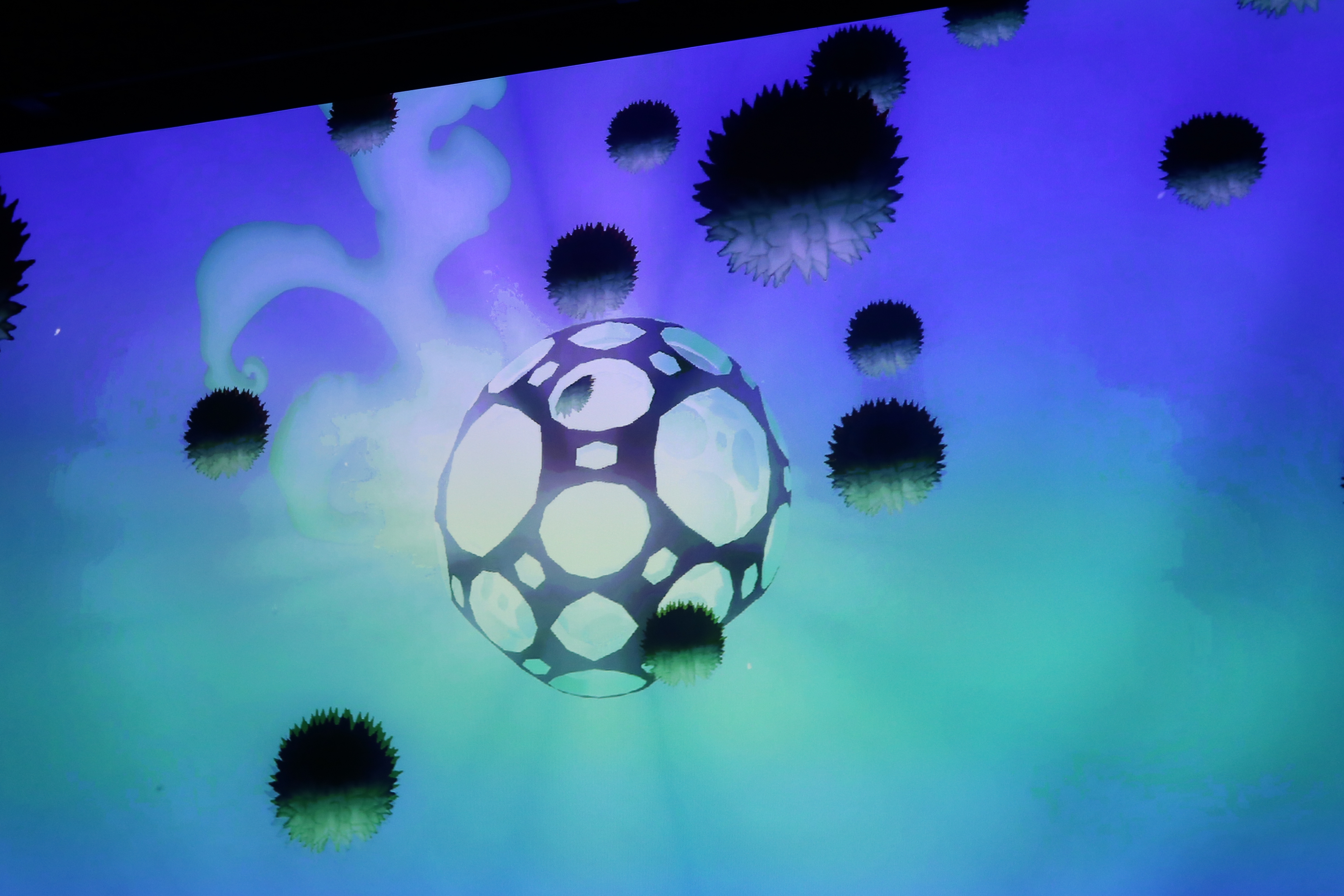


This performance was inspired by Helen Kennedy’s book Games, Gender and Identity: A Case Study in User Experience of Video Games (2007)
In it, she quotes
"Too evanescent? Too intimate? Too frivolous? Too chaotic? Too emotional? Too bodyful? The list of adjectives typically implemented to dismiss dance as a subject deserving of serious intellectual analysis bears a striking resemblance to those stereotypical qualities attributed to the feminine and/or the non-white. (Foster, Rothfield and Dunagan 2005)”
Both dance and games share a history of being dismissed as unserious art forms because of gendered, racialized, and bodily associations.
“Exploring a game also involves being scripted, or choreographed by the game … dance and gameplay involve bodily actions that are scripted by a choreographer or a program. In both cases, success is a matter of adhering our movements to specifications; if you want the rush you have to move.”
Players learn combos, gestures, or sequences in games. Both are practices of embodied literacy.
This is praxis y’all!!
If dance and games are both dismissed because of their embodied, ephemeral qualities, Indigenous thinkers remind us that these very qualities are where worlds are made. I’ve been learning from Indigenous scholars like Sarah Hunt and Dwayne Donald, who show that choreography is not just aesthetic but relational, collective, and tied to land.
Their work makes me ask: what would it mean for game design to take this playfully?
In Indigenous frameworks, choreography is collective, reciprocal, land-based. In most games, choreography is coded by designers, often reproducing colonial or capitalist logics. So, as a performance, Calling Mother Whale uses decolonial game design that treats choreography as ethical relationality. But if I am defend games as art through their kinship with dance, I must also guard against appropriation. Dance in Indigenous contexts is not “just movement,” but tied to ceremony, land, and law. For games to claim that kinship, they must also grapple with land and relationality, not just aesthetics.
comiVideogames
Games | performance + divination | Films | Comics + zines | painting + sketches